

Growing up on the north side of Chicago, we did not have much, but my parents encouraged us to revel in our imaginations. Television shows like G.I. Joe fueled most of our play, and since we could not afford action figures, my cousins, my brother, and I became the characters ourselves. While everyone fought over portraying the ninja suited Snake Eyes, I usually picked Gung-Ho, a Marine who coincidentally looked like an extra from the Village People. My outfit was camo pants, a tactical belt with a canteen, and a military hat, but the centerpiece was a jean vest that let me show off my bare arms and chest. With a pen, I tattooed the Marine logo across my chest and drew on a mustache.
Once dressed, we acted out episodes and created endless storylines of our own. Even with neighborhood friends, it was impossible to match the scale of the show’s battles. Our parents, seeing our enthusiasm, eventually bought us a few toys for birthdays and Christmas, but it was impossible to keep pace with the ever expanding lineup of characters, vehicles, and accessories. The only way to stage epic battles was to invite friends and pool our collections. I remember watching with jealousy and a little shame as other boys showed off platoons of figures and fleets of vehicles compared to my small squad.
Collaboration also brought conflict. Toys had a way of disappearing after gatherings. While some figures could be replaced at Sears, others required mailing in proofs of purchase from the packaging. To settle disputes, my mom painted the bottom of our soldiers’ feet with red nail polish. It was a clever solution, but not without its drawbacks. Explaining why my favorite symbol of courage and machismo had a pink underfoot was never easy.
When we moved to the suburbs, my brothers and I kept building our collection. Each purchase had to be debated and negotiated since we pooled our resources. Commercials constantly dangled new characters and vehicles before us, not to mention temptations from other franchises like He-Man, ThunderCats, Transformers, and Star Wars. For most kids, it was a literal arms race to see who had the best collection. Toymakers competed too, constantly one upping each other. Then in 1985, Hasbro dropped what felt like the atomic bomb of toys, the U.S.S. Flagg aircraft carrier.
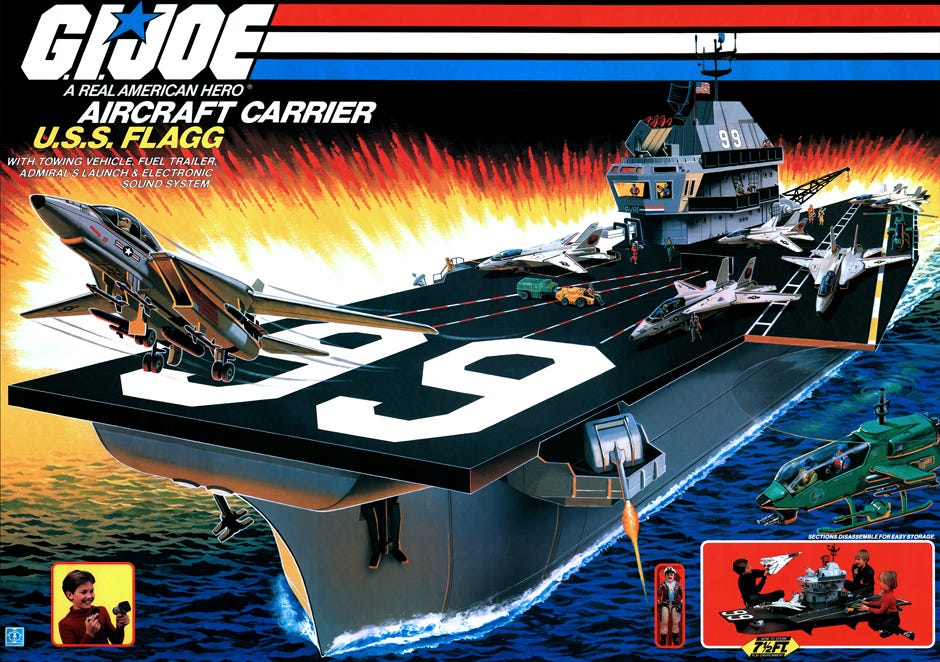
At seven and a half feet long and two and a half feet tall, the Flagg could hold half a dozen jets and helicopters. Few of us actually owned that many aircraft, but practicality did not matter. Every kid wanted the largest toy ever made. It became schoolyard legend. At lunch and recess we schemed about how to beg our parents for it. We whispered about a rich kid in a nearby town who supposedly had one, though no one could confirm it. Retailing at over one hundred dollars, more than three hundred in today’s money, it was out of reach for most families, especially for a single mom raising four boys. Still, my brother and I kept dropping hints about a combined Christmas and birthday gift until we were nearly eighteen.
What we did not know was that our mother had been listening. Through the Sears layaway program, she scraped together the payments, working extra jobs and even overpaying by fifty dollars to secure it. The day we opened that box, our elation was matched only by the enormity of the toy itself. It was bigger than our beds, too large for our rooms, and too much for the living room. The only place it fit was the attic. Up we went. We laid plywood over the scratchy insulation to keep from falling through the ceiling and spent hours piecing together hundreds of parts.
Once assembled, it became our fortress of imagination. No matter the season, my brothers and I climbed the attic ladder, freezing in winter and sweating through summer, to play for countless hours. We did not have the fleet of planes or sailors to match its scale, but that did not matter. Our mom had made it happen.
Even today, people online doubt the U.S.S. Flagg ever really existed or that anyone owned one. But we did. And for once, we were not the kids with too little. We were the ones with the toy everyone dreamed about. We did not get it the first day, and it took years of sacrifice to arrive, but it did.
In the end, this Christmas story became an allegory for my family’s legacy. We started with little, but through sacrifice and persistence, we made it, because my mom was our Real American Hero.
Wonderful story, well told. And helps make sense of a few things...
Your mom is the real deal! A super hero through and through. Your love and admiration for your mom is what makes this memory so beautiful. Thank you for sharing.